

Ask ten people what a research analyst does and most will say the same vague thing: they study stocks. True, but useless. The real job has a shape and a rhythm, and almost none of it looks like the multiple-choice exam that lets you into it. Here is a real day, hour by hour.
The NISM Series XV syllabus describes the knowledge an analyst must hold. It says nothing about how that knowledge is used between nine in the morning and seven at night. That gap is why so many candidates clear the exam and still have no idea what they are signing up for. So set the syllabus aside for a moment, and follow the day.
Before the market opens
The day starts early, well before the first trade. The analyst scans overnight news on the companies they cover, global cues, and anything that moved while India slept: a results announcement, a regulatory order, a sharp move in a peer, a commodity price. All of it is read for one question, does anything here change my view? Models get nudged, notes get flagged, and a short morning summary often goes out to the sales desk before the bell.
Calls, channel checks, and the thesis
As the session runs, the work turns outward. The analyst talks to company management, suppliers, dealers, and industry contacts, the channel checks that test whether a company's story holds up in the real world. A management call might confirm a demand trend; a dealer might quietly contradict it. This is where a thesis is built or broken, far from any textbook. The analyst is not chasing tips. They are gathering evidence for a view they will have to defend.
Picture it concretely. A company guides for a strong festive season, and the stock has already moved on the promise. The analyst does not just accept the guidance and move on. They call two distributors in different regions, check whether stock is actually moving off shelves, and compare it against last year. If the channel says demand is soft while management says it is booming, the analyst has found the gap between the story and the reality, and that gap is exactly where a useful, differentiated view comes from. The common mistake juniors make is treating a management call as fact rather than as one more claim to verify.
Writing the note, past compliance
The output of all this is writing. In the afternoon the analyst turns evidence into a research note: a clear recommendation, a target, the reasoning, and an honest account of the risks. Then it goes through compliance, because a SEBI-registered analyst works inside rules on disclosure and conduct. A careless line can hold up publication or, worse, breach a regulation. The note that finally goes out is precise on purpose.
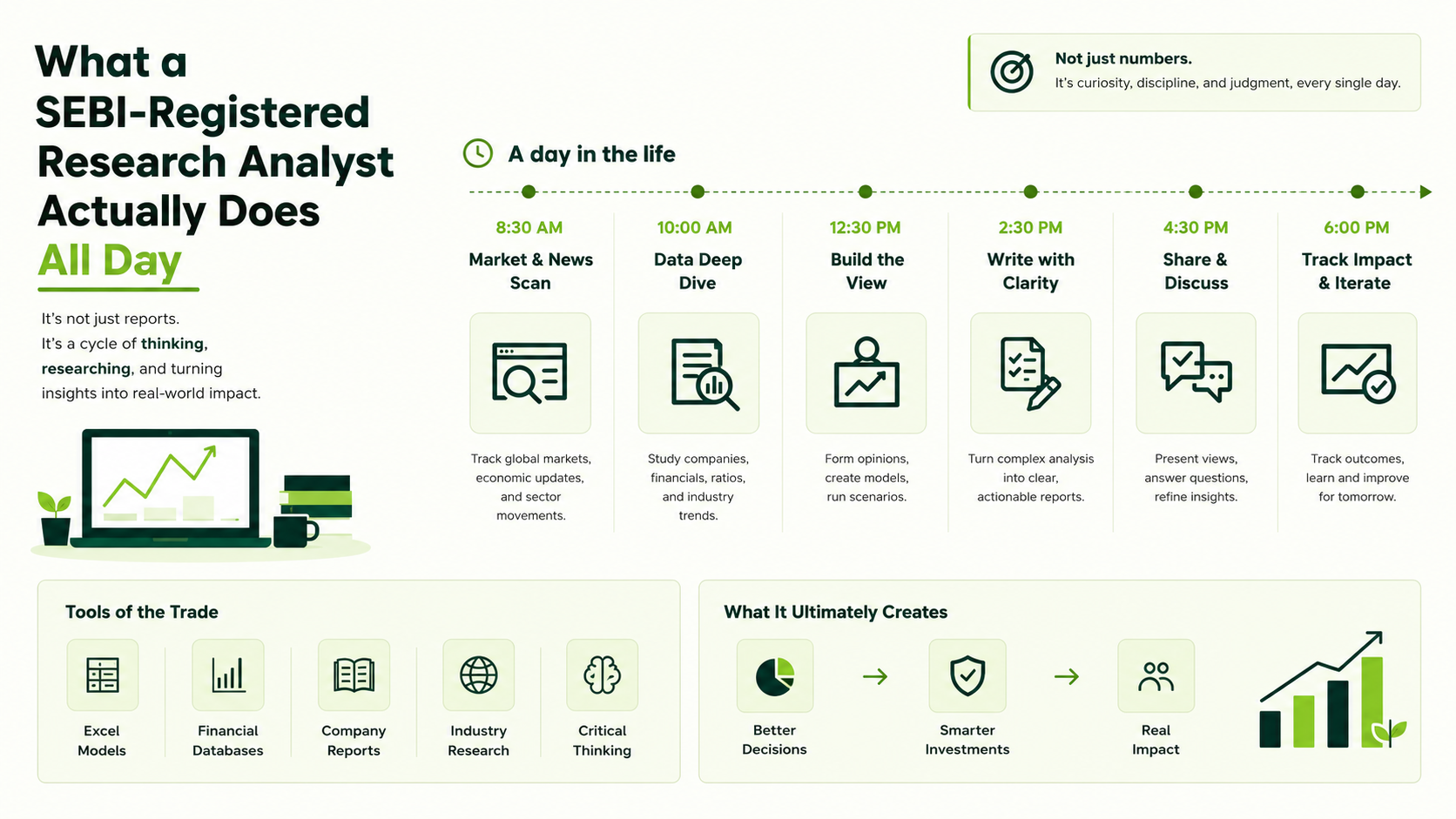
What the syllabus covers, and what it doesn't
Line the day up against the XV syllabus and the overlap is only partial. The exam gives you the valuation grammar, the disclosure rules, and the regulatory frame, all of which the analyst leans on daily. But the craft itself, model maintenance, channel checks, and note writing under deadline, sits outside the syllabus. The exam is the ticket. The desk is the job, and they are not the same thing.
What keeps you in the seat
Notice what the day is mostly made of: reading and writing, not trading. The analyst rarely picks stocks all day long. They build a reasoned view on a small set of companies they know deeply, then defend it. The skill that decides who keeps the seat is judgment, the ability to weigh messy evidence and commit to a call, which is exactly what no exam can certify, and exactly the kind of desk-ready judgment our applied training at Fin Maverick is built to develop alongside the exam itself.
See the job for yourself
Want a real feel for the role before you commit to it? Spend one week living a small version of the day:
- Pick two listed companies and read every piece of news on them for five days.
- Each morning, write two lines: did anything change your view, and why.
- Find one industry data point, a price, a volume, a dealer comment, that tests the company's story.
- Write a one-page note at week's end with a clear call and the risks to it.
- Notice how little of this the exam ever asked of you. That gap is the job.
Frequently asked questions
What does a SEBI research analyst do every day?
They track assigned companies, update models, talk to management and the supply chain, and publish notes with a clear view. Mostly reading and writing, not trading.
Is the job the same as the NISM XV syllabus?
No. The syllabus gives the regulatory and valuation base; the daily job is model maintenance, channel checks, and note writing under deadline.
Do analysts pick stocks all day?
Rarely. The output is a reasoned view on a few names they cover deeply, not a stream of calls.
How many companies does an analyst cover?
Entry analysts often support a senior on 10 to 15 names, then grow their own coverage.