

Plenty of people take NISM Series VIII expecting it to teach them how to trade derivatives. It does not, and believing it will is a costly misunderstanding. The exam certifies that you understand the mechanics and rules of equity derivatives. Whether you can actually trade them profitably is a different question entirely, and the gap between the two is wide.
This is not a knock on Series VIII. It does its job well: it ensures you know how futures and options work, how they are cleared and settled, and the regulations around them. But the syllabus and the trading desk are not the same place, and confusing exam knowledge with trading skill is how people lose money feeling qualified. Let us separate the two clearly.
Who NISM VIII is for
Series VIII is aimed at anyone working in or entering equity derivatives, dealers, trading operations staff, and others who need certified knowledge of how these instruments work. For many dealing and derivatives roles it is a widely expected qualification. It is also useful for serious learners who want a solid, structured grounding in the mechanics. What it is not is a trading course, and the people who benefit most are clear-eyed about that distinction going in.
What the syllabus covers
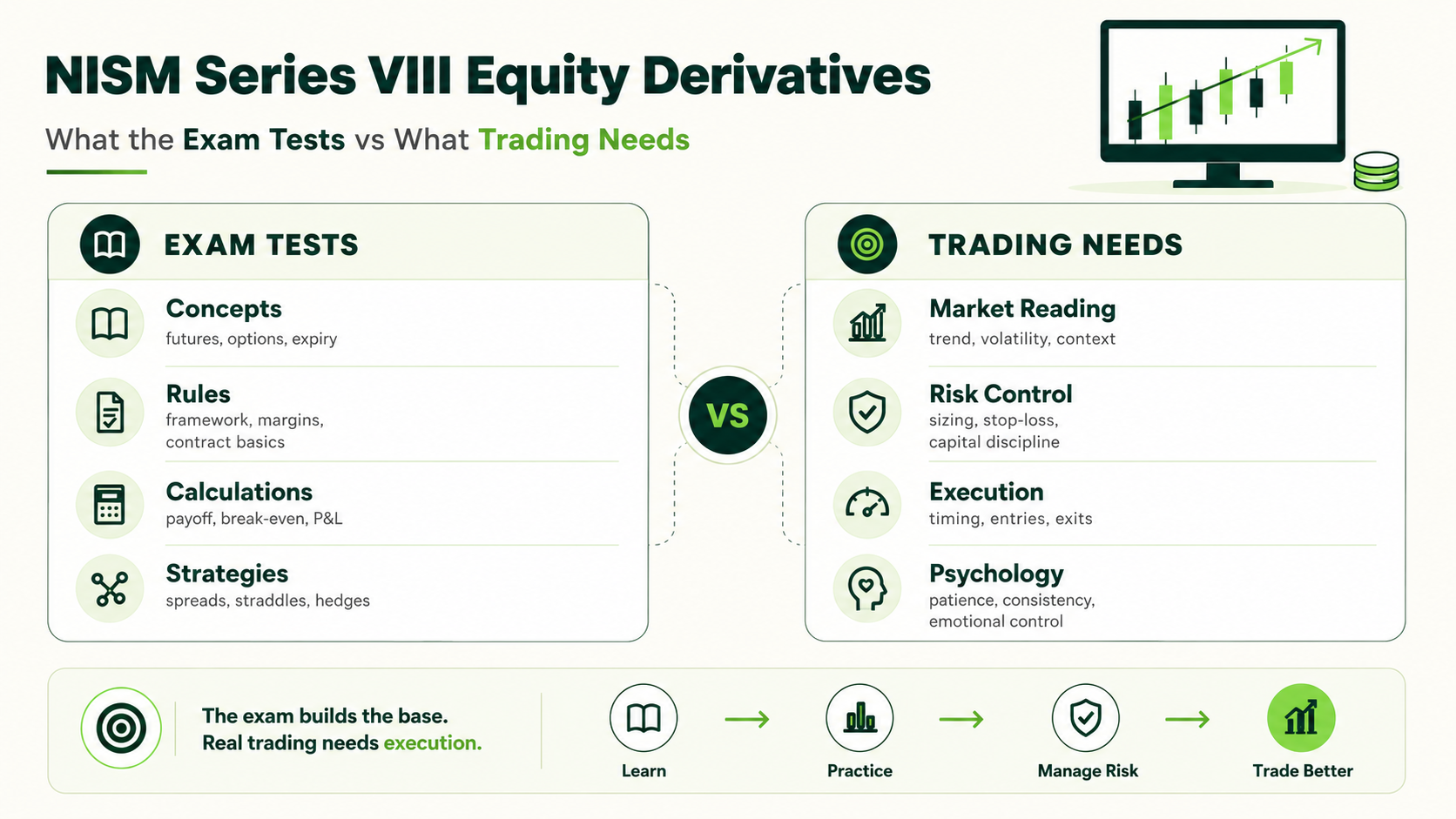
The exam covers the machinery of equity derivatives: what futures and options are, how they are priced in principle, trading mechanics, margins, clearing and settlement, and the regulatory framework. It is a thorough grounding in how the system works, the plumbing and the rules. This knowledge is genuinely valuable; you cannot operate responsibly in derivatives without it. But notice the nature of it: it is knowledge about the instruments, not skill in deploying them.
What real trading actually demands
Trading demands things the exam barely touches. Risk management, the discipline that keeps a bad trade from becoming a ruinous one. Position sizing, deciding how much to commit. Reading market conditions and managing your own psychology under pressure. These are the skills that separate traders who survive from those who blow up, and they are built through experience, not multiple-choice questions. The exam can certify that you know what a stop-loss is; only practice teaches you to use one when it hurts.
An example makes the gap obvious. Series VIII can confirm you know that a long call option has limited downside and a futures position does not. What it cannot teach is the moment a trade moves against you and every instinct says to hold on and hope. Knowing the textbook risk of a position is one thing; sizing it so a wrong call does not wreck your account, and actually cutting it when you should, is another entirely. The first is on the exam. The second is the part that decides whether you last, and it lives only in disciplined practice.
Where the exam and the desk diverge
The clearest way to see the gap: the exam asks what is this instrument and how does it settle, while the desk asks should I take this position, how large, and when do I get out. The first is knowledge; the second is judgment under uncertainty with money at stake. VIII fully equips you for the first and barely begins the second. Anyone who treats a VIII pass as a licence to trade aggressively has mistaken the map for the territory.
Using VIII as a base, then going further
The healthy way to use Series VIII is as a foundation, not a finish line. Clear it to gain the mechanics and the regulatory grounding, then build the trading skills separately, through study of risk and strategy, disciplined practice, and hard-won experience, ideally with small size while you learn. The exam gives you the vocabulary and the rules of the game. Becoming good at the game is the work that starts after the certificate, not before it, and the kind of judgment our broader applied education at Fin Maverick is built to develop beyond the mechanics the exam tests.
Build beyond the exam
Treat the certificate as a starting line, not a finish:
- Use Series VIII to master the mechanics and regulations, that is its job.
- Study risk management and position sizing separately; the exam barely covers them.
- Learn a few option strategies and, more importantly, when each one fits.
- If you trade, start with small size while judgment is still forming.
- Treat the certificate as the base of your derivatives knowledge, not the whole of it.
Frequently asked questions
What does NISM Series VIII cover?
Equity derivatives: futures, options, trading mechanics, clearing, settlement, and regulation.
Does NISM VIII teach you to trade?
It teaches mechanics and rules. Real trading needs risk management and sizing the exam only touches.
Is NISM VIII difficult?
Moderate. Numerical and strategy topics need practice; the rest is concept recall.
Is VIII required for trading jobs?
It is widely expected for dealing and derivatives operations roles.